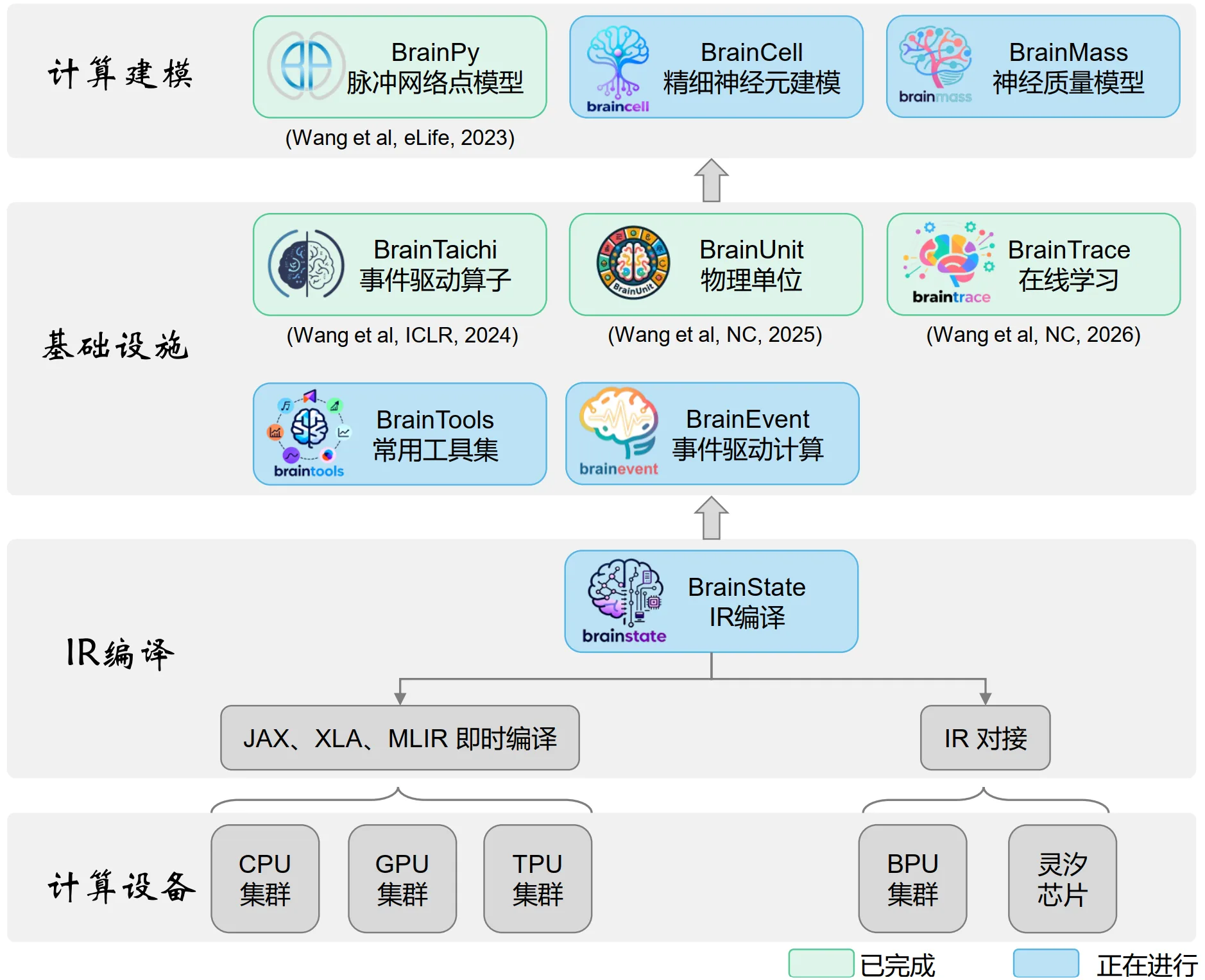


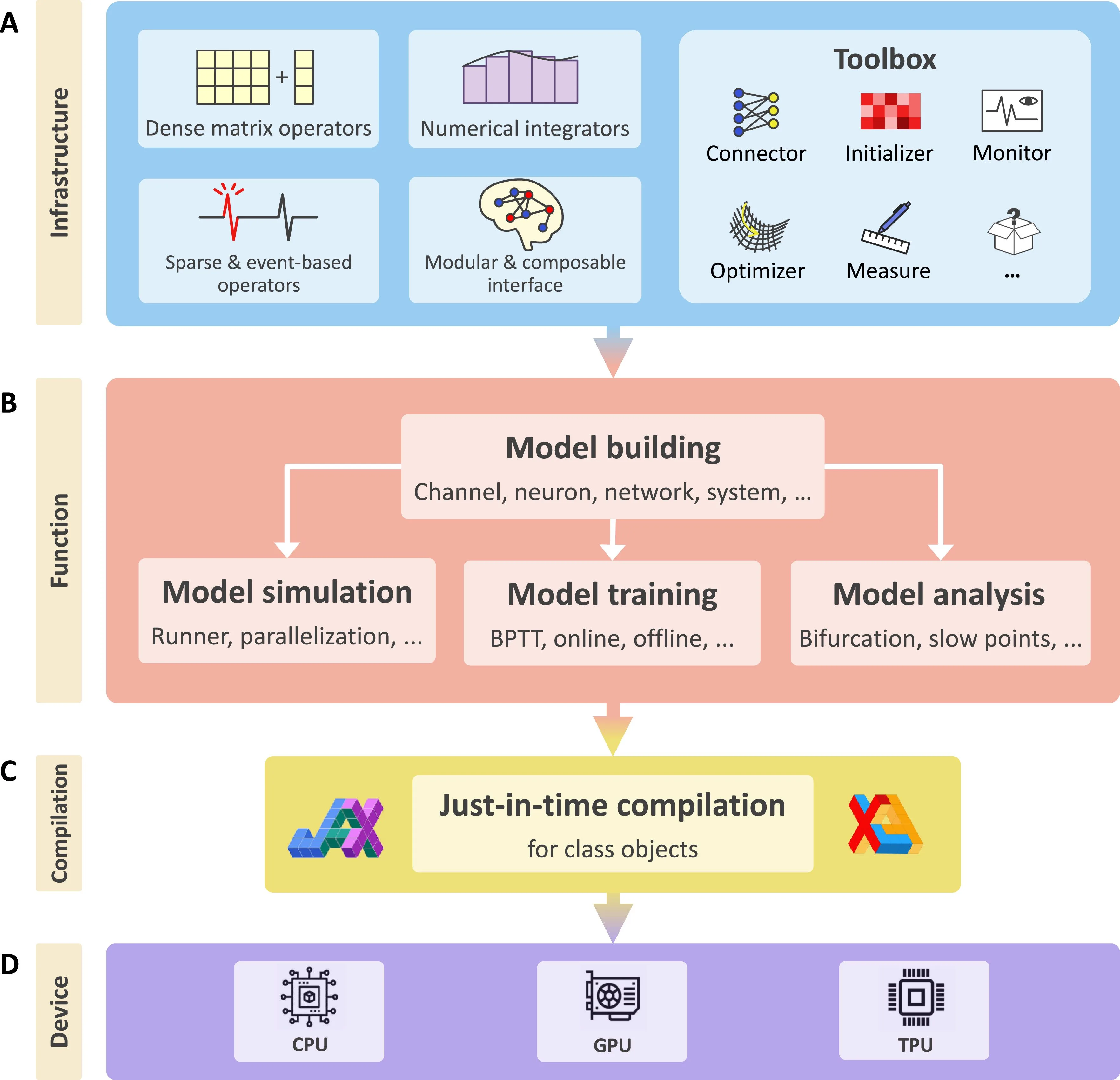
BrainPy is the core general-purpose brain-dynamics modeling framework in the BrainX ecosystem, providing a unified abstraction from scientific models to executable simulations. Rather than serving only as a model library, it organizes neurons, synapses, networks, neural-mass models, learning rules, and experimental workflows as composable, differentiable, and compilable objects, so models across scales and paradigms can be expressed, trained, and reproduced through one interface. Its key innovation is the integration of mechanistic computational-neuroscience modeling with a modern AI compilation stack: built on JAX/XLA, BrainPy brings JIT compilation, automatic differentiation, vectorization, and heterogeneous acceleration to neural dynamics, enabling high-performance simulation, parameter learning, and task-driven optimization for large-scale brain simulation and brain-inspired intelligence. The four items below briefly trace BrainPy through its framework paper, differentiable brain-simulation work, JIT compilation method, and practical book, showing its development from compilation foundations and system design to differentiable simulation and educational practice.